
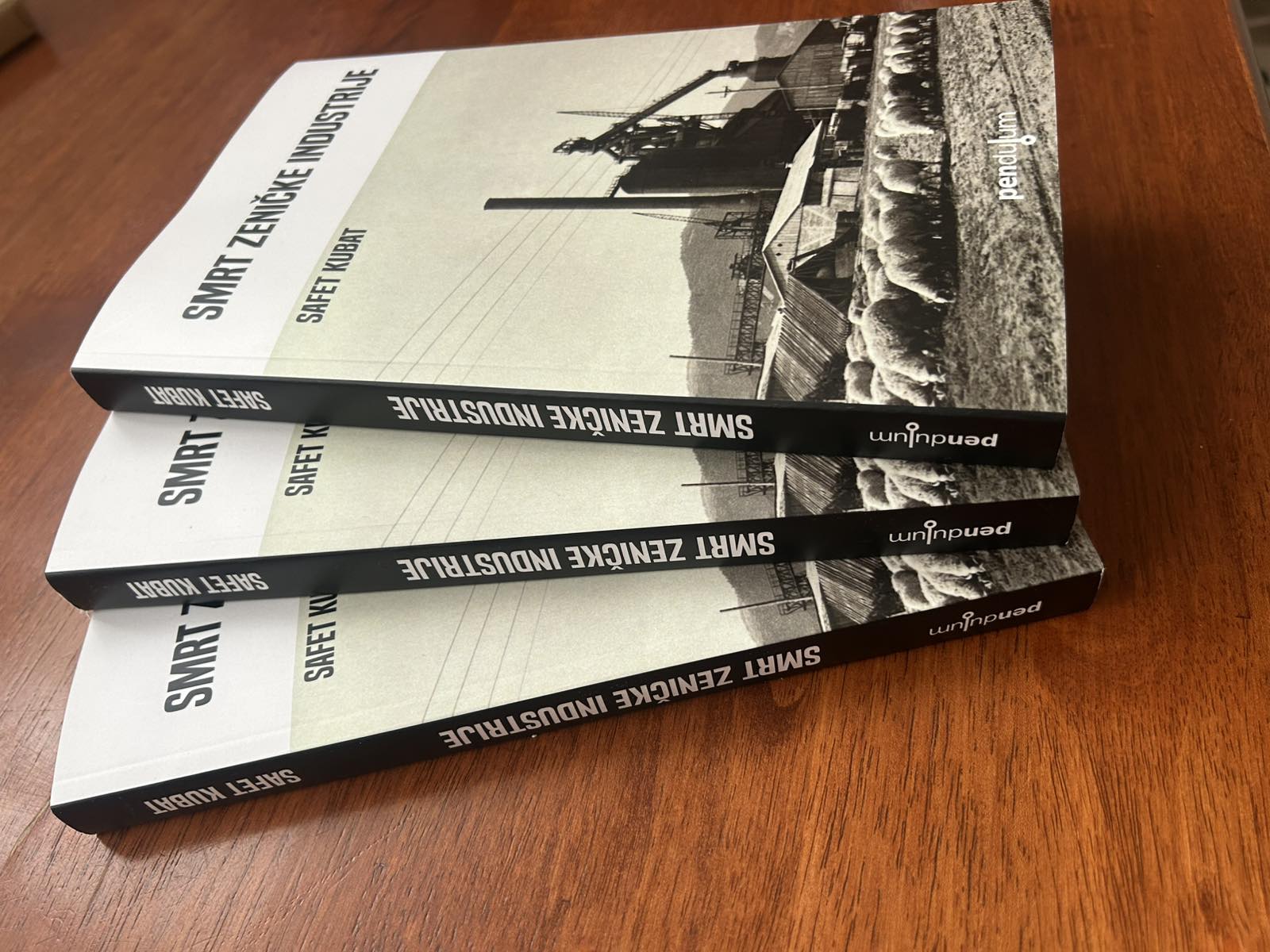
My book, written over many years and completed last year, has just come out of print. The Death of Zenica’s Industry: The End of One Era, the Beginning of Another was not planned to coincide with the unfortunate developments we are now witnessing, the shutdowns and the very real “death” of what once defined the city. Yet, in a way that is both unsettling and telling, the timing aligns.
This book does not reflect the current moment directly. Instead, it anticipates it. It analyzes, warns, and outlines the structural causes that have led us here. More importantly, it does not stop at diagnosis, it offers concrete pathways forward. If you want to understand the full scope of the repercussions ahead, what lies in wait, and to explore archival material hidden from public view, some over 200 years old,this book invites you to do exactly that.
It traces developments from the early 1800s, through the period of Bosnia’s preparation for sale, across Austro-Hungarian rule, the First Yugoslavia, and into today’s neo-colonial contours. At its core, it follows the story of the Zenica Steelworks and the Zenica coal mine, alongside the broader evolution of the city itself, and the realities of contemporary neo-colonialism.
I owe deep gratitude to the staff of the Zenica City Library, where much of this work was written, often quietly, away from public view, in the reading room. Their support in navigating archives and uncovering materials was invaluable. Thankfully, much has been preserved. though we still care far too little for this rich heritage.
My sincere thanks also go to the reviewers:
Prof. Dr. Mirza Džananović, for his outstanding historical analysis of Zenica, and Academician Prof. Dr. Asim Mujkić from the Faculty of Political Sciences, for his political-sociological review.
This book would not exist in its present form without Dr. Nermin Ormanović, Director of the Zenica City Library, who, as chief editor, masterfully guided the process and ensured the work remained authentically rooted in Zenica.
Special thanks to Ajla Suljić for co-editing, proofreading, and language editing, making sure nothing was overlooked.
I am also grateful to the HBS Office in Sarajevo, whose earlier support enabled my research into the Zenica Coke Plant and the Zenica Mine, two chapters of this book build directly on those studies. The third and fourth chapters, along with the preface, are entirely new contributions. One thing is certain: you will not find this information elsewhere.
I only regret that the book was not published earlier, because, unfortunately, much of what it outlines has proven accurate. Still, there is real hope for Zenica—and for Bosnia and Herzegovina,if we respond wisely.
My thanks as well to Prof. Dr. Mario Hibert and Prof. Dr. Petar Jandrić for their collegial reading prior to publication.
More information will follow soon.
This book is a local legacy. Like the ecological movement Rivers of Bosnia and Herzegovina, it remains deeply rooted here, even as our work extends onto the international stage, engaging with global universities and audiences. I speak about Zenica in places like Geneva, Zurich, Paris, and these days, Vienna.
Now you know, about some things kindly, and about others… truthfully.
Finally, my deepest gratitude to my family for their patience. Living with me is not always easy, but without that foundation, nothing else would be possible.
This book is, above all, for Zenica.
It is part of the Political Ecology series.

0 Comments